Why Choose an AC Synchronous Motor for Industrial Use?
An AC Synchronous Motor deserves attention where speed accuracy, efficiency, and continuous operation matter. Its rotor follows the stator’s rotating magnetic field without normal slip. That behavior supports stable speed under changing loads. On a production floor, this can mean steadier conveyor timing, cleaner compressor control, and fewer process variations.
The International Energy Agency reports that electric motor systems consume roughly half of global electricity. Its Energy Efficiency 2023 analysis also identifies motor-driven equipment as a major industrial efficiency opportunity. The U.S. Department of Energy’s Motor Systems Market Assessment confirms that better motor selection can reduce industrial energy use and operating costs. These findings support synchronous technology, especially when equipment runs for thousands of hours annually. However, efficiency claims need real measurements. A poorly sized motor can waste energy, despite an excellent nameplate rating.
Nikola Tesla, whose rotating-field work shaped modern AC machines, said, “The alternating-current motor will be the motor of the future.” His statement still feels relevant, though industrial reality is less dramatic. An AC Synchronous Motor may require a drive, excitation system, or permanent magnets. Installation costs can also exceed those of a basic induction motor. Yet high power factors, precise speed control, and lower losses can repay that investment. Engineers should compare load profiles, starting requirements, maintenance access, and total lifecycle cost. The best choice is not always the newest one. It is the one that performs reliably beside the machine it drives.
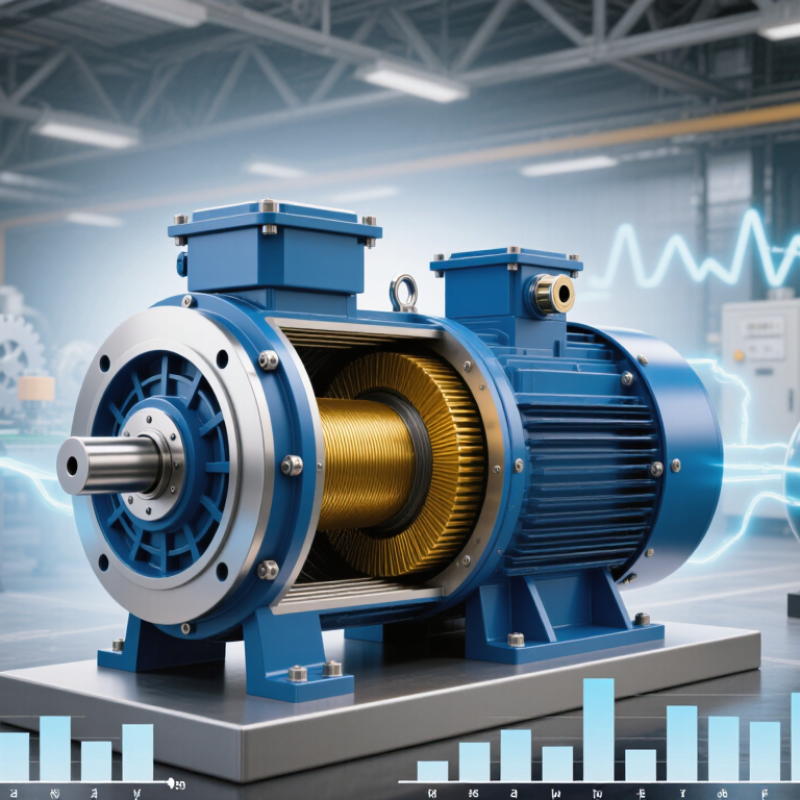
An AC synchronous motor converts electrical power into mechanical rotation through a rotating magnetic field. The stator receives three-phase AC power and creates that field. The rotor then aligns with it and rotates at the same electrical speed. The rotor follows. No slip.
Its speed is defined by n = 120f/p, where n is speed, f is supply frequency, and p is pole count. Permanent magnets or a separately excited winding can produce the rotor field. A variable-frequency drive usually controls starting and speed changes. At steady operation, the rotor remains synchronized with the stator field, even under changing load conditions.
This principle suits compressors, pumps, conveyors, and precision production lines. Constant speed can improve process stability. Adjustable excitation can also support power-factor correction, reducing reactive current in some installations. The International Energy Agency reported that electric motor-driven systems consumed about 53% of global electricity in its Energy Efficiency 2017 analysis. Small efficiency gains therefore matter at plant scale.
The U.S. Department of Energy’s motor-system guidance identifies industrial motor systems as major electricity users, often approaching 70% of industrial consumption. A synchronous design may lower operating losses, but selection is not automatic. Drives, cooling, harmonics, starting behavior, and maintenance access must be checked. Calling the motor maintenance-free would be careless. Field commissioning can expose vibration or control issues that a nameplate never shows.
| Dimension | Technical Information | Industrial Benefit |
|---|---|---|
| Definition | An AC synchronous motor is an alternating-current motor whose rotor rotates at the same speed as the rotating magnetic field produced by the stator. | Provides constant-speed operation under steady-frequency conditions. |
| Operating Principle | The stator creates a rotating magnetic field. The rotor magnetic field locks onto this rotating field, causing the rotor to turn in synchronism with it. | Supports precise and predictable motion in industrial equipment. |
| Synchronous Speed | Synchronous speed is calculated as Ns = 120f / P, where Ns is speed in revolutions per minute, f is supply frequency in hertz, and P is the number of poles. | Enables engineers to select a motor speed based on the power-system frequency and pole count. |
| Typical Speed Behavior | Once synchronized, the motor runs at synchronous speed and does not experience normal operating slip between the rotor and stator fields. | Maintains stable speed for processes that require consistent throughput or timing. |
| Speed Regulation | With a stable AC frequency, speed regulation is inherently precise. A variable-frequency drive can adjust operating speed by changing the supplied frequency. | Improves process control in pumps, compressors, conveyors, fans, and precision machinery. |
| Power Factor | Synchronous motors can operate at a leading, unity, or lagging power factor depending on rotor excitation and operating conditions. | When properly specified and controlled, the motor can help improve power-factor performance in an electrical system. |
| Efficiency Potential | The absence of normal rotor slip can reduce certain rotor-related losses. Actual efficiency depends on motor design, load, cooling, excitation, and operating point. | Can support lower energy consumption in continuous-duty applications when correctly sized. |
| Load Capability | The motor can deliver rated torque while remaining synchronized. Excessive load or a severe disturbance may cause loss of synchronism. | Provides reliable performance when the motor is matched to the required starting, running, and transient loads. |
| Starting Characteristics | Many synchronous motors are not inherently self-starting and may require a damper winding, an auxiliary starting method, or a suitable variable-frequency drive. | Requires appropriate starting equipment and control planning, especially for high-inertia loads. |
| Torque-Speed Relationship | After synchronization, the rotor speed remains tied to supply frequency. The motor develops torque by maintaining an angular relationship between the rotor and stator magnetic fields. | Useful for applications where speed consistency is more important than natural speed variation with load. |
| Control Options | Control may use field excitation, permanent magnets, or electronic commutation through a variable-frequency drive, depending on the motor construction. | Allows the design to be adapted to constant-speed, high-efficiency, or variable-speed industrial systems. |
| Common Industrial Applications | Typical applications include large pumps, compressors, fans, blowers, conveyors, rolling equipment, machine tools, and high-precision positioning systems. | Suitable for continuous-duty systems that value efficiency, stable speed, or power-factor control. |
| Maintenance Considerations | Maintenance requirements depend on the rotor design. Systems with brushes, slip rings, or separate excitation may require additional inspection compared with brushless designs. | Maintenance planning can be tailored to the motor construction, operating environment, and duty cycle. |
| Environmental Factors | Performance is influenced by ambient temperature, altitude, dust, moisture, cooling method, enclosure type, and installation conditions. | Correct environmental selection helps protect insulation, bearings, windings, and control components. |
| Main Advantages | Constant synchronous speed, high speed accuracy, potential for high efficiency, and adjustable power-factor characteristics. | Can reduce process variation and improve the electrical performance of suitable industrial installations. |
| Main Limitations | Starting may require additional equipment, control systems can be more complex, and synchronism can be lost if the load exceeds the motor’s capability. | Requires careful sizing, starting analysis, protection, and commissioning. |
| Selection Checklist | Evaluate rated power, required torque, starting method, speed, duty cycle, supply frequency, voltage, control method, enclosure, cooling, efficiency, and environmental conditions. | Improves reliability, energy performance, and lifecycle cost control. |
Note: Actual performance ratings vary by motor design, operating conditions, control method, and applicable electrical standards. Always verify technical data against the manufacturer’s certified documentation for the selected motor.
It converts electrical power into mechanical rotation. The rotor follows the stator’s rotating magnetic field. At steady operation, there is no slip.
Three-phase AC power creates a rotating magnetic field in the stator. The rotor aligns with this field and rotates at matching electrical speed. The rotor follows.
Use the formula n = 120f/p. Here, n is speed, f is frequency, and p is the pole count. More poles usually mean lower speed.
They suit compressors, pumps, conveyors, and precision production lines. Stable speed can improve process consistency. Less vibration helps.
Adjustable rotor excitation can support power-factor correction. This may reduce reactive current, cable losses, and panel heating. The result depends on the complete installation.
Start with the load profile, not the nameplate. Measure torque, speed range, starting frequency, and operating hours. Ask for measured data. A neat spreadsheet can still mislead.
Confirm starting torque, shaft dimensions, braking needs, bearing loads, and controller compatibility. Review cooling, insulation, harmonics, and maintenance access. Peak torque alone is not enough.
No. Inspect bearings, insulation, cooling passages, alignment, vibration, and temperature. Dusty workshops need regular cleaning. Maintenance-free is careless wording.
Avoid excessive oversizing and sizing only for peak torque. A motor may overheat during repeated starts. Field conditions can differ from calculations. That deserves skepticism.
An Ac Synchronous Motor operates by creating a rotating magnetic field that keeps the rotor synchronized with the frequency of the AC power supply. This design delivers stable speed, precise operation, high efficiency, and strong power-factor performance, making it valuable for industrial systems that require consistent output and controlled energy use. Compared with less specialized motor types, it can reduce speed variation and support demanding continuous-duty applications.
Common uses include pumps, compressors, fans, conveyors, production equipment, and other machinery operating under steady or carefully controlled loads. Selecting the right motor requires evaluating rated power, voltage, speed, torque, duty cycle, load characteristics, environmental conditions, and control requirements. Proper installation should include accurate alignment, suitable protection, correct wiring, and effective cooling. Depending on the application, variable-frequency drives or other control systems may be used to manage starting and operation. Regular inspection, lubrication where applicable, connection checks, temperature monitoring, and timely maintenance help preserve reliability and extend service life.

 Sunvim Motor