Choosing a Permanent Magnet Motor is not simply a matter of selecting the highest efficiency rating. The correct choice depends on load profile, speed range, duty cycle, cooling conditions, and available installation space. A motor driving a conveyor behaves differently from one powering a surgical pump or an electric vehicle. The label may look similar, but the engineering demands are not.
Professor Jacek F. Gieras, a recognized authority on permanent magnet machines, stated, “Permanent magnet machines are characterized by high efficiency and high power density.” That principle explains their appeal, but it does not remove the need for careful evaluation. Buyers should compare continuous torque, peak torque, base speed, overload capacity, demagnetization resistance, controller compatibility, and maintenance requirements. A compact motor can deliver impressive performance. It may also produce excessive heat if ventilation is poor.
Real-world selection often involves compromise. A high-speed design may reduce size, yet require a more advanced inverter and stronger bearings. A low-cost model may meet the data-sheet target, but perform poorly during repeated starts. I have seen specifications appear convincing until the motor faced dust, vibration, or long operating hours. That experience deserves attention.
This guide explains how to assess a Permanent Magnet Motor with practical engineering judgment. It considers performance, reliability, operating cost, and application risk. No single motor suits every project. The best decision comes from matching measured requirements with credible technical evidence, not from trusting impressive marketing language.
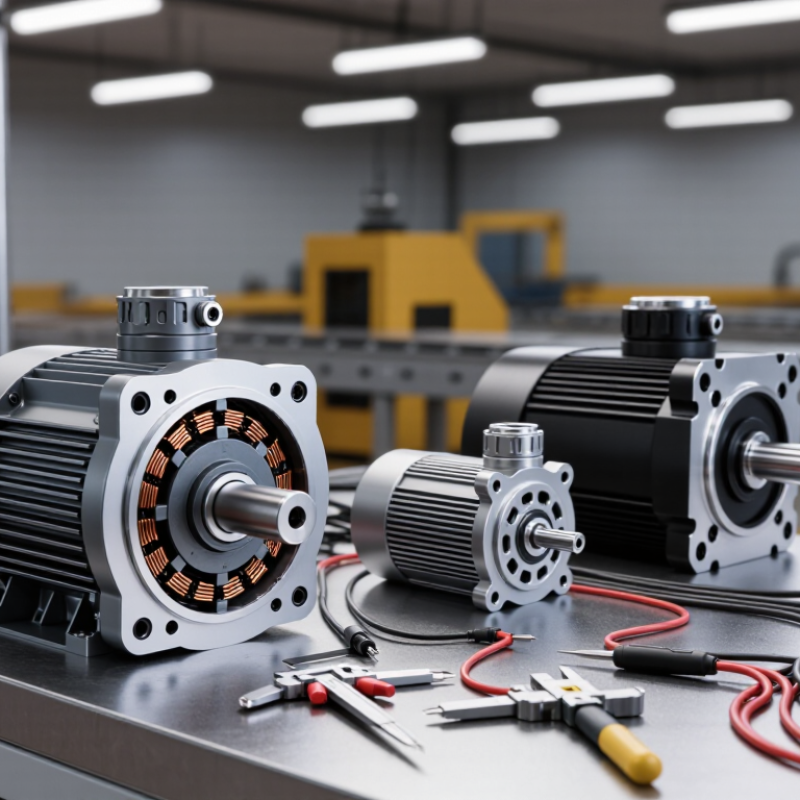
How to Choose a Permanent Magnet Motor?
Define the operating requirements before comparing motor models. Start with the load profile, not the catalog rating. Record continuous torque, peak torque, speed range, acceleration time, and daily operating hours. A conveyor may run steadily, while a robotic axis can demand repeated short bursts. These duties need different thermal designs. The U.S. Department of Energy reports that motor-driven equipment uses about 68% of industrial electricity. Small sizing errors can therefore create large operating costs.
Temperature and installation conditions also matter. Measure ambient temperature, enclosure space, altitude, dust, moisture, and cooling airflow. A permanent magnet motor may deliver excellent efficiency, yet poor ventilation can reduce its usable output. Check the required overload period and insulation class. Then match the drive system to the motor’s feedback, speed control, and braking needs. Field engineers often find that peak torque receives too much attention. Continuous heating is usually the quieter problem.
Efficiency data should be viewed across the complete duty cycle. The International Energy Agency identifies electric motor systems as responsible for more than 40% of global electricity consumption. That figure supports careful selection, but it does not replace real measurements. Use measured load data when possible. A neat spreadsheet can still miss startup friction or unexpected shock loads. I would also leave a modest thermal margin, without oversizing blindly. Oversizing may increase cost, reduce efficiency at light load, and complicate control.
| Operating Requirement | What to Define | Typical Engineering Reference | Selection Guidance for a Permanent Magnet Motor |
|---|---|---|---|
| Required Output Power | Continuous mechanical power and short-term peak power | Power is calculated as P = T × n / 9550, where P is in kW, T is in N·m, and n is in r/min. | Choose a motor whose continuous rating exceeds the calculated continuous load. Check peak capacity separately for acceleration, lifting, or overload events. |
| Torque Requirement | Continuous torque, starting torque, acceleration torque, and peak torque | For a constant-power load, torque decreases as speed increases. High-inertia loads may require substantially higher acceleration torque than running torque. | Compare the complete torque-speed curve, not only the rated torque. Confirm that the motor can start the load without exceeding its peak-current limit. |
| Operating Speed | Minimum, rated, maximum, and allowable overspeed | Permanent magnet motors commonly operate from low speed to several thousand r/min, depending on motor design, bearings, rotor construction, and drive. | Ensure the required speed lies within the motor's base-speed and field-weakening range. Verify mechanical overspeed limits before final selection. |
| Duty Cycle | Continuous running, intermittent operation, cycles per hour, and rest periods | Continuous duty produces the highest steady thermal load; frequent starts and stops increase RMS current and heating. | Size the motor using RMS torque and thermal calculations for the complete cycle rather than using only the average load. |
| Supply Voltage and Current | Available DC bus or AC input voltage, current limit, and voltage variation | The inverter or servo drive must match the motor's electrical characteristics and provide sufficient voltage for the required speed. | Confirm rated voltage, phase configuration, back-EMF, peak current, and drive compatibility. Include low-voltage and high-voltage operating conditions. |
| Control and Position Accuracy | Speed regulation, positioning accuracy, synchronization, and response time | Sensorless control can suit many speed applications, while encoders or resolvers are generally used when precise position or low-speed control is required. | Specify the feedback device, resolution, communication interface, and control-loop requirements before selecting the motor and drive as a system. |
| Acceleration and Inertia | Load inertia, acceleration time, deceleration time, and braking method | Acceleration torque is approximately T = J × α, where J is total reflected inertia and α is angular acceleration. | Check motor-to-load inertia matching, regenerative energy, braking resistor requirements, and the drive's DC-bus overvoltage protection. |
| Thermal Conditions | Ambient temperature, installation altitude, enclosure, and available airflow | Motor output may need derating at high ambient temperature, high altitude, restricted airflow, or when mounted in a confined enclosure. | Use the manufacturer's derating data and verify winding, bearing, magnet, and drive temperatures under the worst operating condition. |
| Cooling Method | Natural convection, forced air, liquid cooling, or external fan cooling | Cooling directly affects continuous torque. A motor stopped or running slowly may receive less airflow when its fan is shaft-mounted. | Select a cooling arrangement that can remove the calculated losses at the lowest operating speed and highest ambient temperature. |
| Environmental Protection | Dust, water, chemicals, vibration, shock, humidity, and washdown exposure | Ingress-protection requirements are application-dependent; dust-prone or wet areas generally need a suitably sealed enclosure and cable entry. | Define the required IP rating, corrosion protection, insulation system, mounting arrangement, and vibration rating for the installation site. |
| Mechanical Interface | Frame size, shaft dimensions, mounting, coupling, allowable radial load, and axial load | Bearing loads and shaft overhung loads can limit motor life even when power and torque ratings are adequate. | Match the motor to the machine's mounting and load geometry. Use a gearbox or flexible coupling when speed or torque conversion is required. |
| Efficiency and Energy Use | Expected annual operating hours, load profile, and energy-cost priority | Permanent magnet motors generally avoid rotor copper losses and can provide high efficiency, especially at variable speed and partial load. | Compare system efficiency, including the motor, inverter, gearbox, and cooling equipment, across the actual load profile. |
| Reliability and Maintenance | Expected service life, maintenance access, bearing service, and operating criticality | Permanent magnets do not require rotor excitation power, but bearings, insulation, sensors, and inverter components still require appropriate maintenance. | Review bearing life, insulation class, sensor replacement procedure, spare-part availability, and protection against demagnetizing over-temperature or fault current. |
Record continuous torque, peak torque, speed range, acceleration time, and daily operating hours. Start with the load profile. A conveyor may need steady torque, while a robotic axis may require repeated bursts. Catalog ratings alone can mislead.
Continuous torque determines long-term heating during normal operation. Peak torque shows short-term capability, but it does not reveal sustained thermal stress. Quiet heating can become the real problem.
Check ambient temperature, enclosure space, altitude, dust, moisture, and cooling airflow. Poor ventilation can reduce usable output, even with an efficient motor. Measure the temperature after continuous operation.
Examine efficiency across the complete duty cycle, not one speed point. Use measured load data when possible. A neat spreadsheet may miss startup friction or sudden shock loads. Real measurements are better.
Brushless DC motors use electronic commutation and often suit pumps, fans, and compact drives. They may show torque ripple at low speed. Permanent magnet synchronous motors usually provide smoother torque under controlled operation. Their results depend strongly on the inverter and feedback system.
Surface-mounted designs can support efficient constant-speed operation and simpler manufacturing. Their magnets face greater demagnetization risk during overload. Use careful overload testing. The attractive option may not survive every duty cycle.
Interior designs improve rotor strength and add reluctance torque. They can support high-speed and traction applications. However, control and rotor design may be more demanding. More capability can mean more complexity.
Axial-flux motors can provide thin packages and high torque density. Cooling and manufacturing consistency may be harder to manage. Compact does not always mean simple. I would verify thermal results before deciding.
Request torque, efficiency, noise, vibration, and temperature-rise data at your actual voltage. Test the real duty cycle and overload period. Check controller compatibility, feedback behavior, braking, and sensor-failure response. I would not trust one attractive test result.
Choosing the right Permanent Magnet Motor begins with clearly defining the operating requirements, including load, speed range, torque, duty cycle, environment, and available power supply. These factors help narrow the selection between different motor types and determine which features are most suitable for the intended application. It is also important to compare rated performance, energy efficiency, starting characteristics, speed regulation, and control system compatibility to ensure stable and reliable operation.
Before making a final decision, evaluate installation space, cooling conditions, protection requirements, expected service life, and maintenance accessibility. A motor that performs well in a laboratory may not be appropriate for demanding industrial conditions without proper protection and support. Finally, compare the total cost of ownership, including purchase price, installation, energy consumption, maintenance, and potential downtime. The best choice is the Permanent Magnet Motor that provides a balanced combination of performance, reliability, efficiency, control flexibility, and long-term value for the specific application.

 Sunvim Motor