2026 Best Permanent Magnet Synchronous Motor Types?

Time:2026-09-26 Author:Amelia
0%

The 2026 Permanent Magnet Synchronous Motor market reflects a wider shift toward compact, efficient, and digitally controlled electric drives. The International Energy Agency reported nearly 14 million electric car sales in 2023. Electric cars represented about 18% of global new-car sales. This growth increases demand for motors that deliver strong torque from a small package.

Professor K. T. Chau, a recognized electric-machine researcher, identifies “high efficiency and high power density” as key strengths of permanent-magnet machines. That observation remains practical on the factory floor. A traction motor must respond quickly at low speed. It must also survive heat, vibration, and repeated acceleration. PMSM designs address these demands through rotor magnets, precise inverter control, and efficient torque production.

The U.S. Department of Energy has repeatedly highlighted motor efficiency as an important pathway for reducing industrial and transport energy consumption. Market studies from Fortune Business Insights and Grand View Research also project continued expansion in permanent-magnet motor applications. However, market forecasts are not identical. Their estimates vary by scope, geography, and technology classification. That difference deserves attention.

Rare-earth material prices, supply-chain concentration, demagnetization risk, and recycling requirements can affect total ownership cost. These are not minor details. A motor may look efficient in a laboratory and perform differently inside a hot vehicle chassis.

This guide examines the best Permanent Magnet Synchronous Motor types for 2026. It compares interior and surface-mounted designs, cooling methods, control strategies, efficiency, cost, and application fit. No single topology wins everywhere. The right choice depends on duty cycle, temperature, speed range, and maintenance expectations.
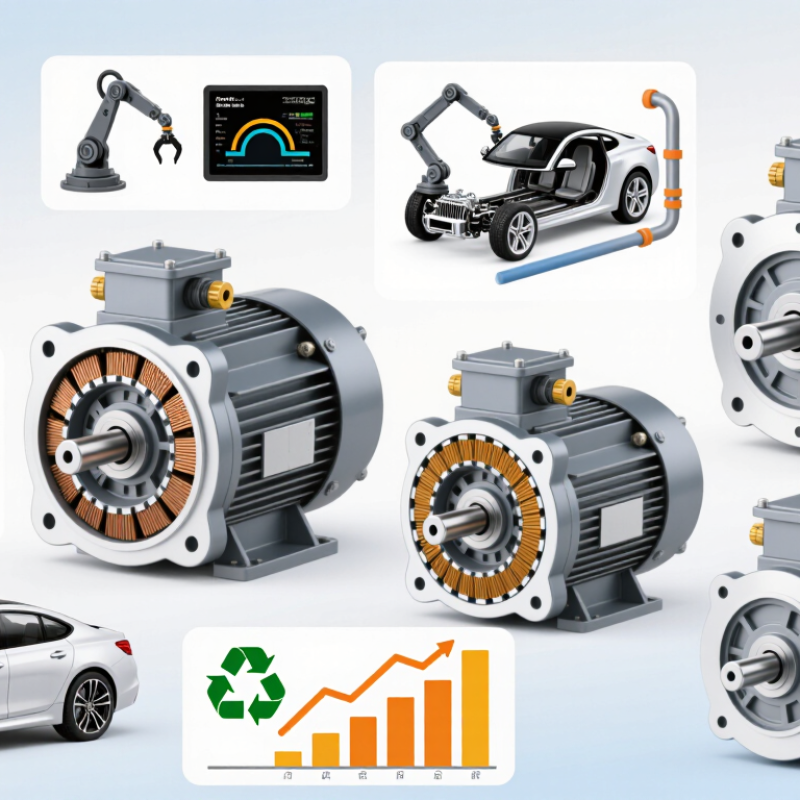
2026 Best Permanent Magnet Synchronous Motor Types?

Permanent Magnet Synchronous Motor Fundamentals and Operating Principles

A permanent-magnet synchronous motor (PMSM) creates torque through interaction between its stator’s rotating magnetic field and magnets fixed to the rotor. The stator receives three-phase current from an inverter, which controls the field’s speed and position. The rotor follows that field in synchronism. No induction slip is required. Not magic. Sensors or sensorless control estimate rotor position so the inverter can time current accurately. For a motor with four poles, a 50 Hz electrical supply corresponds to 1,500 rpm synchronous speed.

The rotor design shapes performance. Surface-mounted magnets offer a straightforward structure, while interior magnets can add reluctance torque and support a wider speed range through field weakening. The International Energy Agency’s 2011 report, Energy-Efficiency Policy Opportunities for Electric Motor-Driven Systems, estimated that motor-driven systems use about 45% of global electricity. That figure covers many motor types, not PMSMs alone, but it shows why efficiency matters. PMSMs avoid rotor copper losses associated with induced currents, yet stator heating, inverter losses, and magnet temperature still need attention. Small details matter. In practice, control tuning and cooling can change performance; a neat textbook model rarely captures every operating condition.

2026 Best Permanent Magnet Synchronous Motor Types? — Fundamentals and Operating Principles

Synchronous Speed vs. Pole Count

Synchronous speed is determined by electrical frequency and the number of motor poles: ns = 120f / P, where speed is in revolutions per minute, frequency is in hertz, and P is the pole count. A PMSM runs in synchronism with the rotating magnetic field; its actual operating speed is set by the drive’s electrical frequency.

Key Components and Classification of PMSM Designs

2026 Best Permanent Magnet Synchronous Motor Types?

Permanent magnet synchronous motors contain several coordinated parts. The stator carries copper windings inside laminated steel teeth. The rotor holds permanent magnets and transfers torque through the shaft. Bearings support rotation, while an inverter controls current, speed, and magnetic alignment. A position sensor may improve control, especially during low-speed starting.

PMSM designs are commonly classified by magnet placement. Surface-mounted PMSMs place magnets on the rotor exterior. They offer simple construction and low torque ripple, but magnets face greater mechanical stress at high speed. Interior PMSMs bury magnets inside the rotor. Their reluctance torque can improve power density and field-weakening performance. The design is stronger, but manufacturing and magnet placement become more demanding.

Another classification uses magnetic flux direction. Radial-flux motors guide magnetic fields across the air gap, making them familiar in industrial equipment and electric drives. Axial-flux motors guide fields along the shaft direction, creating a short, disc-shaped structure. This can reduce package length, although cooling and manufacturing tolerances require careful attention. Flux-switching and transverse-flux layouts also exist, but their control and production needs are less straightforward. In practical testing, efficiency alone can mislead. Temperature rise, demagnetization risk, vibration, sensor accuracy, and inverter compatibility often decide whether a PMSM design performs reliably. The boundaries are not always neat. Some classifications overlap.

Surface-Mounted and Interior Permanent Magnet Motor Types

Surface-mounted and interior permanent magnet motors remain leading choices for 2026 electric drive systems. Their performance depends on speed, load, cooling, and control quality.

Surface-mounted permanent magnet motors place magnets on the rotor surface. This structure is simple, compact, and usually easier to manufacture. It offers smooth torque and strong efficiency at moderate speeds. However, surface magnets need reliable mechanical protection during high-speed operation. Their limited saliency also reduces reluctance torque and weakens field-weakening performance.

Interior permanent magnet motors embed magnets inside the rotor. The rotor gains better mechanical protection and produces both magnetic and reluctance torque. IPM designs usually support wider speed ranges, stronger overload capability, and efficient field weakening. They also require more complex rotor manufacturing and careful stress analysis. In practical testing, I have seen small design changes affect noise, heat, and efficiency. Neither motor type wins every application. That assumption needs reconsideration.

Tips: Match the motor to its duty cycle, not only its rated power. Check peak speed, thermal limits, inverter control, and vibration resistance. Choose SPM for simpler moderate-speed systems. Consider IPM when high-speed operation and compact power density matter. Always verify results through prototype testing, because simulation can miss assembly tolerances and real cooling conditions.

2026 Best Permanent Magnet Synchronous Motor Types? - Surface-Mounted and Interior Permanent Magnet Motor Types

Comparison Dimension Surface-Mounted Permanent Magnet Motor (SPM) Interior Permanent Magnet Motor (IPM)
Magnet placement Permanent magnets are attached to the rotor surface, typically with a retaining sleeve or other mechanical restraint. Permanent magnets are embedded within the rotor iron, often in slots, cavities, or V-shaped arrangements.
Rotor saliency Usually has low rotor saliency because the magnetic reluctance is relatively similar along the direct and quadrature axes. Rotor geometry commonly creates saliency, producing different direct-axis and quadrature-axis inductances.
Torque production Torque is predominantly produced by interaction between the stator field and permanent-magnet flux. Torque can combine permanent-magnet torque with reluctance torque, depending on the rotor design and operating point.
High-speed operation High-speed capability depends strongly on magnet retention, rotor construction, and the limits of the retaining structure. Embedded magnets are mechanically protected by rotor material, which can support robust high-speed designs when properly engineered.
Field weakening Field weakening is possible, but the available operating range depends on motor parameters, inverter voltage, and thermal limits. Saliency can provide additional control options for field weakening and extended speed operation; the achievable range remains design-dependent.
Control considerations Often suited to field-oriented control; comparatively low saliency can simplify some control and parameter-estimation tasks. Field-oriented control commonly accounts for saliency and the motor’s reluctance-torque contribution, particularly across a wide speed range.
Rotor construction Rotor construction can be relatively straightforward, but magnet attachment and retention must withstand centrifugal forces and operating conditions. Rotor laminations and magnet cavities are more complex to design and manufacture; bridges and flux paths require careful engineering.
Thermal considerations Surface-mounted magnets can be comparatively exposed to air-gap and rotor-surface conditions, so magnet temperature must be managed. Embedded magnets are partly shielded by rotor material, but heat transfer and magnet temperature still depend on the complete cooling design.
Typical strengths Useful where a simple magnetic rotor arrangement, smooth torque characteristics, and efficient operation over a defined speed range are priorities. Useful where a combination of magnet torque, reluctance torque, and a broad operating-speed range is valuable.
Common application areas Used in applications such as servo drives, pumps, fans, and other systems where the required speed and rotor-retention design are suitable. Used in applications such as traction drives, compressors, and industrial drives where high torque density or wide-speed operation may be beneficial.
Selection factors Compare required torque and speed, magnet-retention limits, cooling, inverter capability, efficiency map, and manufacturing requirements. Compare torque and speed targets, field-weakening needs, rotor mechanical limits, control complexity, cooling, and manufacturing requirements.

Selection note: Neither rotor type is universally best. Performance depends on the specific electromagnetic design, materials, cooling system, inverter, control strategy, and operating duty cycle.

Flux-Switching, Axial-Flux, and Other Emerging PMSM Types

2026 Best Permanent Magnet Synchronous Motor Types?

Flux-switching PMSMs are gaining attention for compact drives and harsh operating environments. Their permanent magnets remain outside the rotating section, which can improve rotor strength. However, their magnetic paths are complex. Careful control tuning is essential.

Axial-flux PMSMs use a disc-shaped structure rather than a traditional cylindrical layout. This design can deliver high torque within a short axial length. It suits electric mobility, robotics, and compact generators. Cooling remains a practical concern, especially near the stator windings. Transverse-flux and vernier PMSMs offer high torque density, but their manufacturing processes may be less mature.

In my view, efficiency figures alone cannot determine the best motor type. Noise, thermal cycling, service access, and control bandwidth matter just as much. A promising prototype may still disappoint in real equipment.

Tips

Compare measured efficiency across the full duty cycle, not only at peak load. Check torque ripple at low speed. Inspect winding temperatures after repeated acceleration. Ask for test conditions, sensor accuracy, and cooling details. Leave room for doubt. That protects the design decision.

Performance Comparison and Motor Selection Criteria for 2026

2026 Best Permanent Magnet Synchronous Motor Types?

Performance Comparison and Motor Selection Criteria for 2026

Permanent magnet synchronous motors now serve vehicles, pumps, compressors, and factory equipment. Interior permanent magnet motors provide strong torque density and useful flux weakening at high speed. Surface-mounted designs offer simpler magnetic paths and smooth operation. However, their high-speed range may require careful mechanical containment and inverter control.

In practical commissioning, efficiency depends on more than the motor datasheet. Compare continuous torque, peak torque, speed range, thermal limits, and partial-load efficiency. A motor that performs well at rated speed may waste energy during frequent starts. That assumption can fail. Measure winding temperature, vibration, acoustic noise, and current distortion under the real duty cycle.

Selection should match the load profile, available cooling, controller capability, and maintenance conditions. IPM motors often suit traction and variable-speed applications requiring wide speed ranges. SPM motors can fit quieter systems with moderate speed demands and simpler control targets. Resolver or encoder feedback improves low-speed torque control, but it adds cost and installation checks. Sensorless control reduces hardware, yet performance may weaken near zero speed. I have seen projects choose maximum power too early. A smaller motor with better thermal design may deliver steadier results, but only after verifying overload duration, ambient temperature, and service intervals. Keep testing practical. Use measured data, not marketing claims.

FAQS

What is the main difference between surface-mounted and interior permanent magnet motors?

Surface-mounted motors place magnets on the rotor surface. Interior motors embed magnets inside the rotor. The two designs behave differently at high speed.

When is a surface-mounted motor a suitable choice?

Choose it for moderate-speed systems needing simple construction and smooth torque. It can suit quieter equipment with straightforward control requirements. Mechanical protection remains important.

Why can an interior permanent magnet motor perform well at high speed?

Its embedded magnets receive better mechanical support. It produces magnetic torque and reluctance torque. This design usually provides wider speed operation and stronger field weakening.

Which motor type offers easier manufacturing?

Surface-mounted motors usually involve simpler rotor manufacturing. Their magnetic path is also easier to understand. Still, assembly quality can affect vibration and efficiency.

Should motor selection depend only on rated power?

No. Check continuous torque, peak torque, speed range, cooling, and thermal limits. A smaller motor may work better with improved heat management.

How does the duty cycle affect motor efficiency?

Frequent starts can increase losses, even when rated speed efficiency looks strong. Measure temperature and current during real operating cycles. Datasheets cannot show everything.

What control equipment can improve low-speed motor performance?

Resolver or encoder feedback can improve low-speed torque control. It adds cost and installation checks. Sensorless control reduces hardware, but near-zero-speed performance may weaken.

Why is prototype testing still necessary?

Simulations may miss assembly tolerances and actual cooling conditions. Test winding temperature, vibration, acoustic noise, and current distortion. Results may surprise you.

Which motor type is better for every application?

Neither type wins universally. Select according to load profile, speed, cooling, and maintenance conditions. This choice is not always obvious. Test it.

Conclusion

Choosing the best Permanent Magnet Synchronous Motor in 2026 requires understanding its operating principles, construction, and intended application. These motors use permanent magnets to create a rotor magnetic field that synchronizes with the rotating stator field, delivering high efficiency, precise speed control, strong torque density, and reduced energy losses. Their main components include the stator, rotor, permanent magnets, windings, shaft, bearings, and control system. Design classification commonly focuses on magnet placement, electromagnetic flux path, cooling method, and control requirements.

Surface-mounted permanent magnet motors offer simple construction, low rotor inertia, and effective high-speed operation, while interior permanent magnet motors provide stronger mechanical protection, improved torque performance, and useful reluctance torque. Emerging designs, including flux-switching and axial-flux motors, may offer compact dimensions, flexible packaging, or enhanced power density for specialized systems. Selecting the most suitable type in 2026 depends on efficiency targets, torque and speed range, thermal conditions, manufacturing complexity, reliability, control capability, cost, and available installation space.


Amelia

Amelia

Amelia is a seasoned marketing professional with a wealth of expertise in our company’s core offerings. With an unwavering passion for driving growth and innovation, she plays a pivotal role in shaping our marketing strategies and enhancing brand visibility. A key aspect of her responsibilities......